Automate routine tasks, reduce errors, and boost efficiency with our RPA and intelligent automation solutions. Using tools like Power Automate, UiPath and Automation Anywhere, we help you scale faster by freeing teams for high-impact work.
Boost in Employee Productivity
Reduction in Errors
Decrease in Operational Costs












Our RPA consulting services help streamline operations, cut costs, and eliminate manual work so your team can focus on what matters the most.
Optimize and automate data workflows for higher accuracy, faster processing, and seamless system integration.
Automate customer queries for faster response times, personalized engagement, and optimized resource allocation.
Streamline invoicing and reporting while minimizing fraud, enhancing compliance and expediting your financial workflows.
See how our RPA services, powered by UiPath and Power Automate, and other automation tools, streamline routine tasks, slash errors, and free your teams to focus on strategic work.
As a premier robotic process automation consulting firm, we help businesses automate complex tasks, reducing resources and costs.
RPA
RPA
RPA
At Kanerika, we leverage the IMPACT methodology to drive RPA projects, focusing on delivering tangible outcomes.
We leverage the latest advancements in Robotic Process Automation (RPA) technology to deliver powerful solutions that meet the evolving demands of your business.









Our team of RPA specialists combines deep industry knowledge with technical mastery. We leverage cutting-edge tools to craft customized automation solutions that deliver real-world benefits across various sectors.


Our commitment to staying at the forefront of RPA technology ensures our solutions are constantly evolving to optimize processes, boost efficiency, and keep you ahead of the curve.

The pivotal partnerships with technology leaders that amplify our capabilities, ensuring you benefit from the most advanced and reliable solutions.
Traditional automation handles simple, fixed rules on predictable inputs. File transfers, scheduled reports, basic system triggers. It does what it is told, nothing more. RPA goes further: it mimics human actions inside software systems — clicking buttons, entering data, reading screens — to automate rule-based tasks across applications without touching underlying code. It is accessible, fast to deploy, and works across almost any enterprise system.
Intelligent automation adds AI to the stack. It combines RPA’s execution capability with machine learning, natural language processing, computer vision, and decision engines. This allows the system to handle variable inputs, interpret unstructured documents, make contextual decisions, and adapt to exceptions — tasks that rule-based RPA alone cannot handle. The progression: traditional automation executes, RPA mimics, intelligent automation reasons.
Kanerika’s intelligent automation service spans all three layers — data processing automation, customer support automation, and financial operations automation — using UiPath, Power Automate, Automation Anywhere, and Blue Prism depending on the use case.
The strongest RPA candidates share three characteristics: high volume, clear rules, and significant manual effort. When a process runs hundreds of times a day, follows predictable logic, and currently requires people to copy-paste, toggle between systems, or re-enter the same data — that is the RPA sweet spot.
Across industries, the highest-performing use cases consistently include:
• Finance: invoice processing, accounts payable, financial reconciliation, regulatory reporting
• HR: employee onboarding, payroll processing, leave management, compliance documentation
• Customer service: query routing, case classification, status updates, ticket logging
• Supply chain: order processing, shipment tracking, vendor communication, inventory updates
• Healthcare and insurance: claims processing, patient data management, policy renewals, prior authorizations
• Banking: loan processing, KYC data collection, compliance checks, fraud alert handling
Kanerika has deployed automation across all six categories for clients including Kroger, Fortegra, Trax, HaulHub, and ABX. The ABX engagement specifically automated legacy pricing workflows, eliminating manual dependency and accelerating pricing update turnaround.
RPA generates 30 to 200% ROI in the first year for well-scoped implementations, according to UiPath research. Most organizations achieve positive ROI within 6 to 18 months. For repetitive, high-volume processes, automation reduces operational costs by 40 to 70%, with accuracy improvement from a typical 85 to 95% for manual processing up to 95 to 99% for automated workflows.
The caveat: ROI is real but not automatic. Implementations that target low-hanging fruit — clearly bounded, high-volume processes with clean data — hit payback fastest. Programs that attempt to automate complex, exception-heavy processes first often stall. Building a business case over 24 to 36 months, with a realistic cost model that includes licensing, implementation, and ongoing maintenance, gives a more accurate picture than headline ROI numbers.
• Average payback period: 6-18 months for well-scoped projects
• Cost reduction: 40-70% for automated processes
• Accuracy improvement: 95-99% vs 85-95% manual
• Processing speed: 3 to 5x faster than human execution
• Fully scaled automation programs can achieve 300% cumulative return (Flobotics research)
Kanerika’s published case study outcomes include 99% reduction in processing time for invoice automation, 90% reduction in manual intervention for order processing, and 45% decrease in maintenance costs — all from production RPA deployments.
RPA costs have two components: platform licensing and professional services for implementation. Platform licensing varies by vendor and usage model. Microsoft Power Automate starts at $15 per user per month for attended automation, and $150 per month for the unattended Process plan. UiPath runs approximately $420 per month for one attended plus one unattended bot at the entry level. Automation Anywhere’s base cloud package runs around $750 per month.
Professional services for implementation typically run $10,000 to $50,000 per bot depending on complexity, integration requirements, and the number of processes automated. A mid-size engagement automating three to five processes across multiple systems generally costs $75,000 to $200,000 all-in for the first phase. The factors that most affect total cost are data quality, legacy system integration complexity, and how much process standardization is needed before automation can begin.
Attended bots work alongside a human. They sit on a user’s desktop, triggered manually or by specific user actions — like a button click or a form submission. They handle the repetitive, time-consuming parts of a workflow while the employee handles the judgment calls and exceptions. Customer service agents, for example, use attended bots to auto-populate fields and retrieve information while still speaking with a customer.
Unattended bots run independently in the background, 24/7, without any human trigger or supervision. They process invoices overnight, run compliance checks during off-hours, or batch-process data while the
team is asleep. Unattended bots are generally more powerful for volume but require more infrastructure setup and governance. Most enterprise programs use a combination: unattended for back-office processing, attended for front-office support.
AI and RPA are complementary, not competing. RPA is the execution layer: reliable, fast, and deterministic. AI is the intelligence layer: it handles unstructured inputs, makes contextual decisions, and adapts to variations. Neither does the other’s job well alone.
In practice, AI expands what RPA can handle. Intelligent document processing uses computer vision and NLP to extract data from variable-format invoices, contracts, and emails — then RPA routes and processes that data across enterprise systems. AI agents handle decision nodes and exceptions that break rule-based automation. RPA ensures those decisions are executed reliably at scale. According to UiPath, once AI was added to their clients’ invoice workflows, 93% of invoices went straight through without manual inspection.
Kanerika’s intelligent automation service is designed around this combined model, integrating RPA platforms with AI capabilities — NLP, OCR, and decision logic — to handle both structured and unstructured process inputs.
The pilot-to-enterprise gap is where most RPA programs stall. A successful pilot proves concept on one or two processes. Scaling to thirty or fifty processes across multiple departments requires something different: a Center of Excellence (CoE), standardized development frameworks, governance controls, and organizational change management.
UiPath describes three stages: laying the foundation (pilot, CoE setup, early governance), scaling across the enterprise (cross-departmental rollout, top-down process prioritization), and becoming a fully automated enterprise (automation embedded in daily work, citizen developers building their own workflows). The organizations that fail to scale typically skip the CoE and governance layer, creating bot sprawl, inconsistent quality, and maintenance overhead that overwhelms the gains.
• Stage 1: Pilot 1-2 high-value, low-risk processes; build initial CoE; establish governance framework
• Stage 2: Prioritize cross-departmental processes; develop reusable components; build internal capability
• Stage 3: Extend to desktop automation; enable citizen developers; automate continuously
• Common failure point: attempting enterprise rollout without a CoE and standardized methodology
Kanerika recommends and implements Center of Excellence frameworks as part of every enterprise automation engagement, covering governance design, development standards, and the organizational model needed to sustain automation programs long-term.
Most RPA project failures trace back to four predictable problems. First: automating the wrong processes. Teams select high-complexity, exception-heavy workflows for pilot projects because they look impressive. When they fail, confidence collapses. The right starting point is high-volume, clearly bounded, low-exception processes.
Second: no process standardization before automation. RPA cannot reliably automate a broken or inconsistent process. Pre-automation process analysis and standardization is not optional — it is a prerequisite. Third: underestimating the maintenance burden. Bots break when underlying systems change. Without a dedicated maintenance model and governance framework, bot sprawl and degradation erode gains over time. Fourth: treating RPA as an IT project rather than a business transformation program, which leads to solutions that work technically but are not adopted by the teams they serve.
Kanerika’s IMPACT methodology builds process analysis and standardization into the pre-build phase of every RPA engagement. The ABX case study is a direct example: the engagement modernized a legacy pricing system before automation, enabling the bot to run reliably rather than inheriting existing process inconsistencies.
Kanerika’s intelligent automation practice covers three service areas: Intelligent Data Processing (automating data workflows for accuracy, speed, and seamless system integration), Customer Support Automation (chatbot-driven query resolution, resource optimization, and personalized engagement), and Financial Operations Automation (invoice and payment automation, compliance-focused record management, and fraud detection).
The platform stack includes UiPath, Automation Anywhere, Blue Prism, Microsoft Power Automate, Pega, OpenRPA, AutomationEdge, and Fortra — the tools are selected based on the client’s existing infrastructure, compliance requirements, and use case characteristics. Engagements follow Kanerika’s IMPACT methodology, covering process discovery, automation design, development, testing, deployment, and post-launch support.
Kanerika has three published RPA case studies with specific, verified outcomes from production deployments.
ABX — Modernizing Legacy Pricing Systems: Improved pricing accuracy, faster turnaround on pricing updates, and reduced manual dependency through automation of a legacy pricing workflow.
Order Processing Automation: 90% reduction in manual intervention, 30% faster order fulfillment capacity, and 55% faster email response — deployed for an enterprise logistics client.
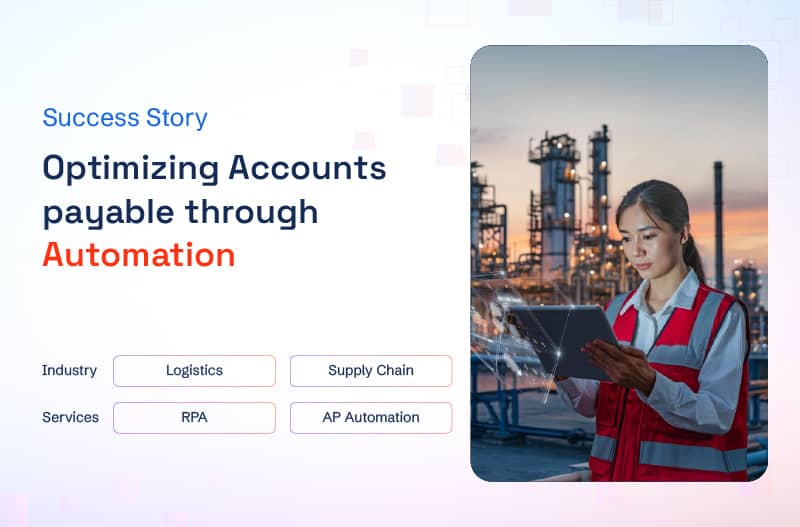
Invoice Processing Automation and Rule-Based Cost Allocations: 45% decrease in maintenance costs, 95% savings in developmental efforts, and 99% reduction in processing time — one of the most significant efficiency gains in the published portfolio.
These outcomes are from live production deployments, not projections.
Every RPA engagement follows the IMPACT methodology through defined phases. It starts with process discovery and assessment: documenting current-state workflows, identifying automation candidates using volume analysis and ROI calculations, and scoping the first phase before any development begins.
From assessment, the team moves through solution design (selecting tools, designing the automation architecture, mapping exception handling and escalation logic), development and integration, testing, and production deployment. Post-launch includes 24/7 monitoring, proactive maintenance, and performance optimization. Change management — training, documentation, and stakeholder enablement — is built into the engagement to ensure adoption, not just installation.
Kanerika has delivered intelligent automation across banking, insurance, logistics and supply chain, manufacturing, automotive, pharma, healthcare, and retail and FMCG. Named clients in the broader portfolio include Kroger, Siemens Healthineers, Sony, Volkswagen, Zydus Cadila, HaulHub, Fortegra, ABX, KBR, and Trax.
Specific automation deployed by industry:
• Banking: loan approval workflows, compliance reporting, KYC data collection (Power Automate and UiPath)
• Insurance: policy renewals, claims processing, data validation (Automation Anywhere)
• Logistics and SCM: order processing, shipment tracking, supplier coordination
• Manufacturing: production scheduling, quality control reporting, inventory updates
• Pharma: document validation, clinical trial tracking, regulatory report generation (UiPath)
• Healthcare: administrative workflow automation, patient data management
• Retail and FMCG: invoice processing, inventory management, pricing updates (Power Automate)
Security and governance controls are built into Kanerika’s automation architecture from the start. Every deployment includes role-based access controls for bot credentials, encrypted data handling in transit and at
rest, detailed audit logging of all bot actions, and exception management protocols that route sensitive decisions to human reviewers.
Kanerika holds ISO 27001, ISO 27701, SOC 2, and ISO 9001 certifications, plus CMMI Level 3 process accreditation. For regulated industries — banking, pharma, healthcare, insurance — deployments are designed for SOX, HIPAA, FDA, and GDPR compliance from the architecture stage. Bot credential management follows secure vault practices with automated rotation. The team also designs Center of Excellence governance frameworks to prevent bot sprawl as automation scales across departments.
Simple automations targeting a single, well-defined process typically go from discovery to production in 4 to 8 weeks. Mid-size implementations covering 3 to 5 processes across multiple systems run 16 to 24 weeks. Enterprise-wide automation programs are phased over 6 to 12 months.
On ROI: Kanerika’s own published case studies show 99% reduction in invoice processing time, 90% reduction in manual intervention for order processing, and 45% decrease in maintenance costs. The RPA market broadly delivers 30 to 200% ROI in year one with payback typically within 6 to 18 months. Kanerika builds ROI baselines into the discovery phase so returns are measured against a defined before-state, not estimated retrospectively.
Three things are worth evaluating directly when comparing automation partners.
First, Kanerika works across the full platform stack — UiPath, Automation Anywhere, Blue Prism, Power Automate, Pega, and others. Many RPA firms are effectively resellers for a single vendor. Kanerika selects tools based on fit, not partnership incentives. Second, CMMI Level 3 process accreditation and ISO 27001, SOC 2 certifications mean governance and delivery quality are independently verified, which matters for regulated-industry clients. Third, the broader technology ecosystem — Microsoft Solutions Partner for Data and AI, Featured Microsoft Fabric Partner, Databricks partner — means automation engagements can connect to enterprise data platforms without forcing separate vendor relationships.
• Multi-platform: UiPath, Automation Anywhere, Blue Prism, Power Automate, Pega, OpenRPA, AutomationEdge, Fortra
• Delivery process: CMMI Level 3, ISO 27001, SOC 2, ISO 9001 certifications
• Data platform depth: Microsoft Solutions Partner for Data and AI, Featured Fabric Partner, Databricks partner
• Production case studies: 99% processing time reduction, 90% manual intervention reduction, 45% maintenance cost decrease
• Cross-industry reach: banking, insurance, logistics, manufacturing, pharma, healthcare, retail across named enterprise clients

We use cookies to give you the best experience. Cookies help to provide a more personalized experience and relevant advertising for you, and web analytics for us.
Limited seats available!